
Transportation

Grede Holdings partakes in EPA ENERGY STAR program

Southfield-based Grede Holdings LLC is committing to EPA's ENERGY STAR program, which has some of the nation's largest companies working to reduce greenhouse gases by conserving energy. Grede, a manufacturer of iron castings, foam, silicon and other products for the transportation and industrial markets, with 3,800 employees at 13 foundries, three machining operations, and its headquarters in Southfield, plans to measure and track its energy performance with tools offered through ENERGY STAR. The company also will develop and implement energy management guidelines for decreasing energy usage. Being an ENERGY STAR company will also have the company promote the importance of energy efficiency to its staff and the community.It's all part of the ENERGY STAR Challenge, which calls on commercial and industrial buildings to improve energy efficiency by at least 10 percent. In return for energy saving achievements, Grede will receive the ENERGY STAR certification, an increasingly ubiquitous symbol on appliances and other consumer products and commercial and industrial buildings. ENERGY STAR began in 1992 in an attempt to curb greenhouse gases and global warming. Last year it had saved Americans, according to the Environmental Protection Agency, about $18 billion on their energy bills while reducing the greenhouse gas emissions equivalent to those of 33 million vehicles.Grede is not disclosing the amount of investment that will go into the project, but there will be a "sound return" on the investment."We believe that a strategic, corporate energy management program will help us enhance our financial health and aid in preserving the environment for future generations," says Doug Grimm, chairman, president and CEO, Grede Holdings LLC.Source: Richard Pacini, senior vice president, Millerschin Group; Doug Grimm, chairman, president and CEO, Grede Holdings LLCWriter: Kim North Shine

Latest in Transportation
Michigan is national leader in street design that serves cars, bikes and pedestrians

The Michigan Complete Streets Coalition is cruising down a path of success as it spreads its campaign of "Building roadways that move people not just automobiles" around the state.Not only did the organization win Campaign of the Year from the Alliance for Biking and Walking at a national summit last week, each week more and more municipalities are signing on to the Complete Streets approach, which means road construction and improvements will take into account non-motorized uses.A total of 32 Michigan communities have passed ordinances or resolutions in support of Michigan Complete Streets. That's the most in the nation, says John Lindenmayer, co-chair of the Michigan Complete Streets Coalition. The coalition is made up of the League of Michigan Bicyclists, the Michigan Environmental Council and AARP. Earlier this month Allen Park became the fourth Wayne County community to pass a resolution. Ann Arbor also signed on last week and Detroit, Ferndale and Royal Oak are among cities working to include all forms of transportation in their road planning."There's been an incredible amount of momentum in this last year and even since August when the Michigan Department of Transportation passed laws" that in part allowed for the distribution of federal funds for road enhancement projects to be used on non-motorized uses, Lindenmayer says.Lindemayer believes an approach like this not only keeps people safer but makes places more livable. And, he believes communities that make themselves more accessible to walkers and bicyclists will be more attractive and successful."You look at all the young talent that's leaving Michigan. They're going to communities where they can walk, ride their bikes, that are more livable," he says. "We're really moving in the right direction -- especially to be known as the auto state, to be leading in this, really says a lot."Source: John Lindemayer, co-chair Michigan Complete Streets CoalitionWriter: Kim North Shine

Rochester Hills’ overpass gets “Complete Street” make-over

Reconstruction at M-59 and Crooks Road this year will do the usual road repair but also use a new approach that takes into account travelers not in cars.Called a Complete Street, the Crooks Road overpass will be built wider and with designated lanes to accommodate bikes and pedestrians. The $8 million project will also lay new sidewalks from Austin to Hamlin roads, Morosi says.The busy intersection is in Rochester Hills and is part of the 2011 construction line-up from the Michigan Department of Transportation. It is one of at least two Complete Street approaches in the package of road construction contracts to be awarded."When we're developing a Complete Street project we're required to meet with the local community to take into account non-motorized uses and facilities. The idea is to make it a more walkable community," says MDOT spokesman Rob Morosi. "Even before the Complete Street legislation we would meet with local communities to see if there's something we can include that the local community has always wanted but has been prohibited to do because of the way the road is constructed," he says.This M-59-Crooks project is "a great example of what we're doing to address that," he says. "So now people riding their bikes or walking won't be in conflict with traffic...People can ride, their bikes, Rollerblade, walk safely."The project is one of many included in $274 million in road contracts to be awarded in 2011 for a four-county area in southeast Michigan. Some 82 miles of road and 105 bridges will be repaired or constructed in Macomb, Oakland, St. Clair, and Wayne counties, which account for 40 percent of traffic in Michigan, according to MDOT.Source: Rob Morosi, spokesman for the Michigan Department of TransporationWriter: Kim North Shine

Virtual 8 Mile shows sky-high views of the 3D street-level

Technology and marketing are converging in a push to promote business, transportation, and commercial development along 8 Mile.If Virtual 8 Mile, an application developed by the Eight Mile Boulevard Association and Plymouth-based Luna Tech Designs, goes as planned the 27-mile corridor can be viewed on a 3D virtual interface using Google Earth.Ideally, visitors to the site can zoom in on member businesses, which also will get Google priority listings during searches for businesses of their type. The $5,000 in funding for the application came from the Michigan Dept of Transportation.Virtual 8 Mile will also show visitors development possibilities and real estate opportunities, including details and photos of available land and property, along the stretch of road that cuts through Wayne and Oakland counties.In addition, the site shows improvement projects, including facade renovations and median gardens, and public transportation routes and other information that can make patronizing a business or starting one easier.For a business such as the Belmont Shopping Center, which now is viewable by visitors, "it is another way to promote an existing tenant mix and is also a business attraction tool for vacancies," says Tami Salisbury, executive director of the 8 Mile Boulevard Association.The 13 communities bordering the Eight Mile corridor, which spans Macomb, Oakland and Wayne counties, stand to gain from increased exposure, Salisbury says."It really is a snapshot of 8 Mile, what's going on there and the potential that is there," Salisbury says.In a larger sense, she says, the project helps the association in its mission to change the reputation, accurate or not, that 8 Mile Road is a has-been. "It's equally as important to change the mental landscape as it is to change the physical landscape," Salisbury says. "We are changing mental perceptions people have of 8 Mile by showing them these physical transformations."Source: Tami Salisbury, executive director, Eight Mile Boulevard AssociationWriter: Kim North Shine

Wayfinding signs with online synch capability are coming to Ferndale
SMART bike rack grant helps Berkley promote cycling

A $2,000 grant from the Suburban Mobility Authority for Regional Transportation (SMART) will pay for at least six additional bike racks and contribute to a larger plan by the city of Berkley to put its residents and workers on two wheels. About a dozen bike racks are currently in place in the city."It's something we're seeing more of, and we want to see even more of," says Tom Colwell, facility manager and parks and recreation director for the city of Berkley.The racks will be installed by July, Colwell says, and will be similar in style to existing ones. Also this summer, the city is launching a bike riding program, and is in the midst of a project to make its roads safer for bikers, perhaps by adding cycling lanes, he says."The bike rack program with SMART is really in line with what we're trying to do," Colwell says.The idea behind the grant is to help residents get around town without cars. SMART buses have bike racks for riders as well."Ultimately we're going to put some of the racks closer to bus shelters and around town," Colwell says. "What we want to promote is people not driving their own cars everywhere, but getting around by biking…We want to promote a healthier lifestyle."Source: Tom Colwell, facility manager and parks and recreation director, city of BerkleyWriter: Kim North Shine

Woodward Avenue gets 50 new signs, All American Road designation

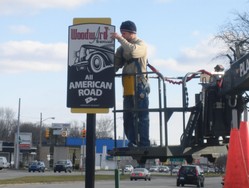
More than 18 months of regional planning and state-local cooperation culminates this week with the installation of federal All American Road signs along a 27-mile stretch of Woodward Avenue.A total of 50 signs worth $45,000 will be installed as part of the 2009 All American Road project, a U.S. Dept of Transportation program that awards funding for roadways deemed worthy of distinction and therefore dollars that make the roadways more appealing, useful, recognizable and memorable. Many such roadways around the country have been deemed scenic parkways, historic routes and such. The majority of Woodward signs will be installed this week by the Michigan Dept of Transportation (MDOT) with a few not coming until spring.Royal Oak-based WA3, the Woodward Avenue Action Association, is the local administrator of the program and worked with MDOT, all cities along the route, and DTE on the best placement and process for the sign installation"The intent is to really bring awareness that this is an exclusive and important designation so that when visitors are here they say, 'Wow I've seen that in other parts of America,' and they understand this is an important part of history," says Heather Carmona, executive director of WA3."They're very different signs, not your typical MDOT road sign...It was a long process, 18-20 months. It was very challenging to get these different signs, but MDOT was very accommodating," Carmona says. "We were able to do something that was outside of the box and get something that was eye catching and appealing and safe." A prototype sign is located at McDonald's on Woodward near 13 Mile.Of the 50 signs, 23 will be installed in Detroit. The remainder run north through Oakland County communities.Source: Heather Carmona, executive director of the Woodward Avenue Action AssociationWriter: Kim North Shine

Case for Detroit light rail grows with $25M federal grant, 23% growth in Amtrak ridership

A system of regional mass transit in southeast Michigan has moved further down the track thanks to a $25 million federal grant and an Amtrak ridership survey that shows the number of train commuters continues to increase. "I believe that southeast Michigan is as close as it has ever been to implementing higher levels of transit," says Carmine Palombo, transportation director for SEMCOG, the Southeast Michigan Council of Governments.  He says SEMCOG and the Michigan Department of Transportation "continue moving forward on the commuter rail project from Ann Arbor to Detroit. Amtrak ridership on the Pontiac to Chicago line is up significantly. These are all positive signs that could lead to enhanced transit being in our future in the not too distant future." The positive prognosis comes after the award of a $25 million grant from the U.S. Department of Transportation for the building of the Detroit Light Rail Line. The grant comes from the Transportation Investment Generating Recovery - TIGER, a program of the American Reinvestment and Recovery Act.  The first phase is the construction of a light rail line that runs 3.4 miles along Woodward and has 12 stations connecting downtown Detroit to Grand Blvd in the New Center area. The second phase would extend the light rail line 5.9 miles from Grand Blvd to 8 Mile Road near the Michigan State fairgrounds. Separately, according to a report from the Michigan Dept of Transportation (MDOT), Amtrak ridership and ticket revenue increased again. From October to December, 130,683 passengers took trains on the Pontiac/Detroit-Chicago corridor -- or Wolverine line -- for an increase of 22.7 percent from a year ago. Ticket revenue increased 26 percent to $4,949,889, according to MDOT. Ridership and revenue also increased on the Blue Water train that goes between Port Huron and East Lansing and the Pere Marquette line between Grand Rapids and Chicago.  Janet Foran, a spokesperson for MDOT, which helps fund the Pere Marquette and Blue Water lines, says "certainly there is a lot more effort in southeast Michigan to get new projects off to a start, one being the Woodward light rail line…Clearly there is much more defined interest train travel." Palombo and Foran say, as always, funding will have to follow the interest. Source: Carmine Palombo, director of transportation for SEMCOG and Janet Foran, spokesperson for the Michigan Department of TransportationWriter: Kim North Shine

Streetscape grants from Royal Oak’s WA3 help unify Woodward Corridor

Five cities and communities with Woodward Avenue as their spine now have money to spend on projects to make their street fronts more appealing, inviting and useful.The money, $53,000 split among them, comes from the Woodward Avenue Action Association (WA3) via Federal Highway Administration Scenic Byway funds. WA3, a Royal Oak-based economic and community development organization with the mission of improving the visual, economic, function and historical character of the 27-mile long avenue, hands out the grants as part of its Streetscape Grant Program.The 2010 recipients run from Detroit north through Oakland County and up to Berkley. In 2009, WA3 awarded $118,000 in mini grants."We're looking for areas that can enhance Woodward as an entire corridor and also help communities fulfill their individual goals," says Heather Carmona, executive director of WA3. The projects are not only aesthetic but practical, she says. And the added bonus is that the grants bring federal tax dollars back home. Woodward Avenue, a history-rich and storied thruway, is designated an All-American Road, making it eligible for the funding.The allocations were:City of Berkley - $8,000 for median improvementsFerndale Downtown Development Authority - $10,000 for Wayfinding Kiosks, high-tech, outdoor directoriesArden Park-East Boston Historic District - $7,000 for historic entry gratesThe Park District (between 6 and 8 Mile roads) - $5,000 for beautificationSouth Oakland county - $13,000 for median improvementsThe program provides a simplified process to generate physical improvements for Woodward as a connected region by celebrating and promoting the byway and the communities it runs through.Source: Heather Carmona, executive director, Woodward Avenue Action AssociationWriter: Kim North Shine

The Night Move

Where there's a need, innovation and entrepreneurship step in. Chris Ramos bought a bus to shuttle Metro Detroit's young professionals into downtown for events. Then he bought another. And another. Now, the carbon-neutral owner of The Night Move has 8 employees, a growing clientele, and high hopes for the region's future.

Our Partners

City of Oak Park

Don't miss out!

Everything Detroit, in your inbox every week.

Close the CTA

Already a subscriber? Enter your email to hide this popup in the future.