
It’s Not Easy Being Green
The economy is struggling. Real estate is in a spiral. How do you make the case for green building when businesses are just trying to survive? And what about those who want to go green but can’t quite reach LEED standards? Is there any consideration for their eco-friendly choices? Metromode looks at how the future of sustainability is coping with the challenges of today.

LEED — Leadership in Energy and Environmental Design — is USGBC
DEFINE tK
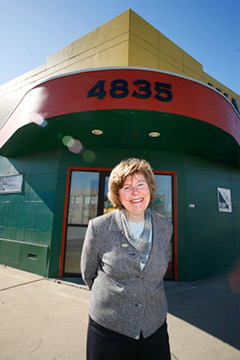 While LEED unquestionably leads the way in green building certification across the country, critics claim it’s not the only path to sustainable development. Its high cost of certification, sometimes-nonsensical weighting of criterion and overall favoritism of new construction versus rehab leave some going green on their own terms.
Metromode decided to explore the topic from three perspectives: environmentalism, design and funding. In other words, who cares, who knows what to do and who’s going to pay for it.
The Treehugger
What’s wrong with LEED? Diane Van Buren Jones SDAT LINK & LINK TO PROFILE OF DVBJ tK
The Architect
Brian Hurttienne joined Detroit-based Hamilton Anderson Associates after tK years of running his own firm, BVH Architecture. At BVH, his firm designed the restoration of the Kales Building and tK. Focus on rehab — reuse inherently greener than new.
Hurrttienne sees the role of the architect as always having been to push a green agenda. “It’s new to everyone else, but to architects, we’ve been doing this forever,” he says. “The principles of architecture are so in tune with the nature of materials, the environment, site and landscaping…it’s hard to change that.”
The stopper, from his viewpoint, has historically been the client. While an architect might suggest better materials up front that will, save in maintenance, operations and energy costs long term, one look at the upfront cost was enough to send them scurrying back to drywall and drivet, single pane windows and a flat black roof.
Now, things are changing. “All clients want to save money,” says Hurttienne. “Capital, upfront costs might be more expensive to go green — but if the payback is within two to three years, they might go for it.”
And it’s not just money, it’s awareness as a whole that has changed. “We can’t write a proposal now without knowing that we’re going to have sustainable issues and design issues to review and go over with our clients,” he says.
Hurttienne sees that currently, most clients going green are those who reap a tangible benefit by doing so — and that is typically larger ones, like banks, insurance companies such as Blue Cross Blue Shield LINK TO PARKING GARAGE PIECE and huge corporations like Ford Motor Co. LINK TO ROUGE STORY.
He explains why this is so: “Clients are on board but, well, they don’t necessarily get funds…they don’t get a prize — it’s more about a good image. So therefore, the clients that want that image go for it. It does improve their image, which improves their bottom line.”
For the rest of his clients, particularly smaller ones that cannot afford full LEED certification, Hurttienne finds ways to nudge them green in a cost-efficient way. Shade devices and insulation. Site positioning a new building in such a way that the maximum amount of natural vegetation is preserved. The installation of an air exchange unit — as opposed to a typical exhaust fan — to improve overall air quality.
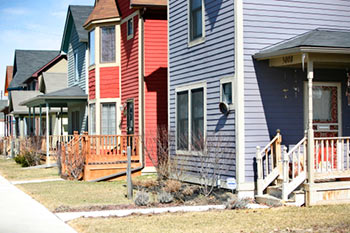 A perfect example is his involvement in the design of two phases of affordable infill housing in the North Corktown neighborhood, the first in 2003 and the latter in 2006. tK
Hurttienne’s final thought: “You can follow LEED guidelines and not do LEED.”
The Banker
John Schoeniger BIO tK — Shorebank description
Schoeniger is aiming to make lemonade out of lemons, by using the current home foreclosure crisis to incentivize green building rehabs.
Carrots and sticks
Take more of a a carrot approach
It either makes a business case or it doesn’t
Tax credit or other subsidy
Triple bottom line
Here in Detroit, big issues are jobs and foreclosures
Workforce is a separate conversation
Works with local real estate investors
A targeted geographic approach
Affordable in Detroit foreclosures
Work with local investors
Return to market responsibly
Energy cost overlooked
Part of affordability
Prove this model
Experiment on a modest scale
Local – more interested
assumption is that local people understand local neighborhood
have more of a stake
lenders used to working with realtors piecemeal
so inundated
figure out wholesale approach
kick the tires a lot
talking to a lot of investors
sweeten pot on normal rehab product
market rate loan 10% take care of rest
don’t see interest rate as motivation
Ford Kresge
Unprecedented collaboration between foundations
Not overlapping or replicating — carving out niches
Pay for transaction cost plug closing, appraisal costs
Before and after, set benchmark for improvement
Say, 30% improvement
Still in formative, do a few in first quarter
Sell or refinance – conventional lender soon
Rate to serve as stick not to hold house indefinitely
$12M loan fund, need to recycle over and over
$50,ooo to buy and fix up, 20 houses with $1 million
Recycle 2 times a yeat
Short term loans over and over Seek input from investors
Unregulated lender
Experienced in a modest way
Find something that works do it over and over again
Bank
Nonprofit lender
TA $ from casinos, foundations — energy efficient audit
Detroit’s not done shrinking yet
Abandoned chaotically
Foreclosure response, wherever responsible rehabbers work
Where will neighborhoods of tomorrow be — targeted approach
Even a couple of blocks — 70 houses — vs 70 all over the city
Opportunity for Detroit to be one of the greenest cities ever
Foreclosure energy efficiency one baby step towards overall greenness
Related Articles

How this Warren Thai market keeps Southeast Asian immigrants connected to home
At the Midwest Buddhist Meditation Center in Warren, a weekly Thai market helps Southeast Asian immigrants maintain cultural connections while introducing visitors to foods and traditions rarely found in local restaurants.
Thumb Art Spark initiative connects artists, communities, and businesses ahead of 2027 public art celebration
Planned for September 2027, the Thumb Art Spark Celebration will bring communities across the region to highlight existing public art, showcase new projects, and give residents and visitors new ways to explore the places where they live.
Partner Partner Content Creativity and community come together at Farmington’s new Art Park Promenade
Farmington’s Art Park Promenade connects Riley Park with the Hillside Townes development through a pedestrian-friendly space filled with landscaping, seating, and public art.


