
Local Alternative Energy Initiatives
Some SE Michigan communities are determined to drop their rustbelt in favor of something a bit more au natural. But it’s not trendiness that inspires cities like Ypsilanti, Ann Arbor and Wyandotte to implement the holy trinity of sustainability –wind, solar, conservation– but rather the greenbacks they’ll save by doing so.
Green is not a color that is usually associated with Metro Detroit. We identify colors like blue with workforce collars and local waterways. Red brings to mind Red Wings and apples. Gray paints pictures of the common sky colors and Rustbelt factories.
But green? In East Lansing, yes, but the chosen color of the environmentally conscious is largely absent when people think of southeast Michigan and the stereotypical images of Zug Island that come with it.
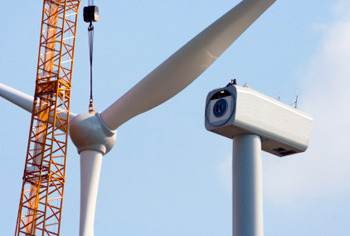 However, a number of grass roots movements in local communities are working to change that by establishing the holy trinity of alternative energy (solar, wind and efficiency) in their respective communities. And, no we’re not just talking about Ann Arbor, Michigan’s golden child of environmentalism.
Wyandotte is preparing to build wind turbines along the Detroit River and is putting up solar panels on schools. Ypsilanti is putting up solar panels, too, and testing out energy efficient LED streetlights. Ferndale is getting ready to install its own LED lights and working to make its fleet of city cars more fuel efficient. County governments are performing energy audits on their buildings not only to save money but burnish their images as places working to stay ahead of the environmental curve.
“There is a real groundswell of support for these sorts of things,” says Ed McArdle, conservation chair of the Sierra Club’s Southeast Michigan Group. “There are a lot of communities doing it on their own.”
Winds of change
Perhaps the biggest change of perception is taking place in Taylor. Long the punch line of what Metro Detroiters wish they weren’t but the way most of the world sees us is now leaping ahead in the alternative energy race.
Downriver’s poster child of 20th Century thinking is now working to erect multi-million-dollar wind farms, is one of the too few Metro Detroit cities to sign the U.S. Mayors Climate Protection Agreement and advocating against sprawl. Believe it or not this is Taylor, the suburb most likely to have the word “tucky” attached to its name, making these moves and blowing away most of Metro Detroit’s other communities.
 “I was a little skeptical of that because I had heard the wind wasn’t so great away from the Great Lakes,” McArdle says. “They said, ‘Think of all of the wind that comes from Metro Airport.’ Not to mention the price of wind energy is coming down and while the coal and nuclear power prices are going up.”
And Taylor is not even at the forefront of developing wind technology in Metro Detroit. That position belongs to another prominent Downriver city, Wyandotte. Wayne County’s second-oldest city is on track to become the first to build wind turbines, putting five up by 2010.
Wyandotte recently finished feasibility studies and is lining up federal funds to put up the $15 million in wind turbines. Each 350-foot-tall structure (with 100-foot-long blades) is expected to produce enough electricity to power 500 homes. That’s enough to satisfy the energy needs of about 20 percent of the occupied homes in Wyandotte.
While so many communities tend to fight these wind-based projects, Wyandottians are pushing hard for it. City officials expect the windmills to not only help power their community and further push its image as a leader of progressive ideas, but they see them turning into a symbol of the city and even helping attract tourism dollars.
“They say beauty is in the eye of the beholder,” says Melanie McCoy, general manager of Wyandotte Municipal Services. “A lot of people say these windmills are beautiful and majestic.”
Solar spotlight
Wyandotte is not putting all of its alternative energy eggs into the wind basket either. Wyandotte Municipal Services is working with the local public school district to put in a $100,000 solar system on Wilson Middle School, which is being done by two local alternative energy start-up companies.
The idea behind the alternative energy diversification is to help the city, which owns its own utility, be ready to meet the state’s proposed alternative energy portfolio standards whenever Lansing gets it act together and actually passes one. City officials see the variety as the spice that will let local residents live the greenest lifestyle possible.
“The opportunities are here and you need to be able to nibble away at all of them,” McCoy says. “That way you can see which ones are the most successful.”
While solar may not have the energy potential in Michigan that wind does (big surprise), it’s not stopping locals from trying to harness it.
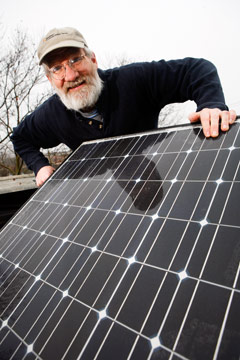 A group of local residents are working to install solar panels on as many institutions with viable southern exposure in Ypsilanti. Solar panels are already up and functioning on the Ypsilanti Food Co-operative and there are plans to put more up on the back of city hall and the Rutherford Pool.
While these efforts are utilizing government grants for funding, they are also depending on local fundraising efforts. In one case, collecting $50 pledges via the Internet. Although the systems are expected to take years to pay for themselves, the idea is to make a statement on where the communities long-term priorities stand.
Dave Strenski, an Ypsilanti resident and admitted technology geek, is one of the everyday citizen activists working to make the solar projects reality. Although he enjoys the solar projects on the technical geek level, his advocacy for them goes beyond that fascination to the simple belief that it’s just the right thing to do. And what better way to get people to pay attention than putting a line of solar panels on one of city hall’s most visible walls.
“There are a lot of people who get it and are doing things,” Strenski says. “But there are a lot of people who don’t get it and I think a demonstration system or something like city hall will send a message. It will be like a billboard for solar energy.”
The cheapest power plant
Of course you can’t talk about solar initiatives without mentioning Ann Arbor. The recently anointed Solar America City is not only working on solar projects for the Ann Arbor Hands-On Museum and Farmer’s Market but it’s also creating incentives and education initiatives for more private solar projects.
However, the city isn’t depending on creating new environmentally friendly ways to create clean energy. It’s spending a lot of resources on figuring out ways to conserve energy, too.
“We want to really emphasize efficiency,” McArdle says. “The more efficiency you have the more alternative energy makes sense. Efficiency is the cheapest power plant in the world.”
To accomplish this the city utilizes its energy office that was birthed in the 1970s energy crisis. It helps make the argument (convincingly) that city elders make environmental issues a priority instead of a cheap headline.
 “The bigger picture issue is we have an energy office,” says Andrew Brix, spokesman for the Ann Arbor Energy Office. “We have a full-time staff here (two full-time and two part-time employees) working just on energy issues.”
Among the solutions it has come up with are turning back on the electricity generators on the Huron River dams, ordering energy audits on city buildings, buying hybrid buses. The city also set out an ambitious plan to have at least 20 percent of its electric needs satisfied by alternative energy sources by 2015.
The LED lights alone are expected to have some of the biggest savings. Although more expensive up front, they use half the energy of a regular light bulb and last four times as long on average. They are expected to pay for themselves within four years and start saving serious amounts of taxpayer dollars after that.
Wyandotte, Ypsilanti, Detroit and Ferndale are all looking into doing the same thing, however, they are still studying the technology. Ferndale is the closest to making a go at it with Ypsi’s Wireless Co-op.
photos:
Turbine installation – istock courtesy photo
Ed McArdle, conservation chair of the Sierra Club – Royal Oak’s Transit Center
Dave Strenski, an Ypsilanti resident, with Ypsi food coop’s solar panel’s
Andrew Brix, spokesman for the Ann Arbor Energy Office, with LED street lamp – Ann Arbor
Photographs by Marvin Shaouni
Marvin Shaouni is the managing photographer for Metromode & Model D.
Related Articles
West End Commons brings community together in downtown Wixom
A years-in-the-making effort to develop a new gathering place in downtown Wixom is nearing completion with the creation of the ‘third space’ gathering center, The West End Commons.
Partner Partner Content Creativity and community come together at Farmington’s new Art Park Promenade
Farmington’s Art Park Promenade connects Riley Park with the Hillside Townes development through a pedestrian-friendly space filled with landscaping, seating, and public art.
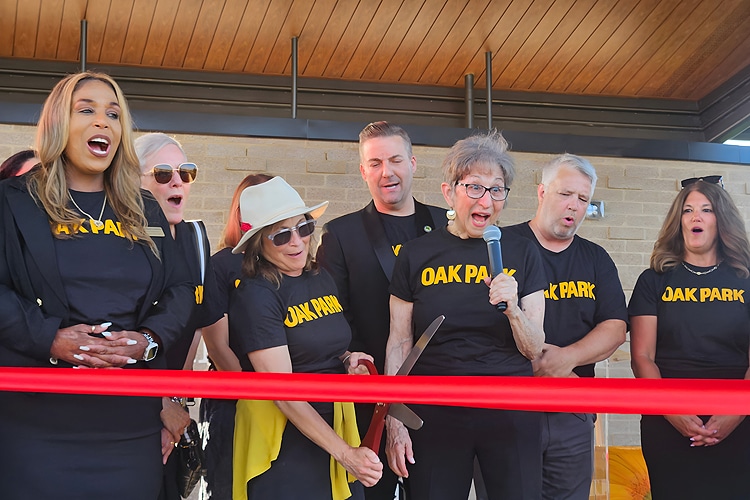
Oak Park opens new event hub, celebrates years of community investment
Oak Park looks ahead after fulfilling promises to residents on the Elevate Oak Park initiative.


