
These 3 Pontiac initiatives are igniting citywide momentum
In Pontiac, a series of ambitious community-driven initiatives is redefining what local revitalization looks like.
In Pontiac, a wave of new initiatives is transforming the way residents experience community, support, and opportunity. From a reimagined school building to downtown redevelopment and green infrastructure, the city is seeing tangible signs of renewal rooted in collaboration and care for residents.
At the heart of this growing momentum is a shared vision: to make Pontiac a place where families can thrive.
“Our vision is that Pontiac’s neighborhoods will flourish as welcoming spaces where all residents feel connected, safe, and empowered to achieve economic stability,”says Erin Casey, director of the Pontiac Funders Collaborative, which is managed by the Community Foundation for Southeast Michigan. “By fostering a resilient community, we ensure that opportunity and prosperity are within reach for everyone.”
Webster Community Center: A resident-driver rebirth

One of the clearest examples of that vision in action is the Webster Community Center, a project led by the nonprofit Micah 6 Community. The historic 1918 school building, which has been vacant since 2007, is being transformed into a multi-use hub for recreation, the arts, education, and essential services.
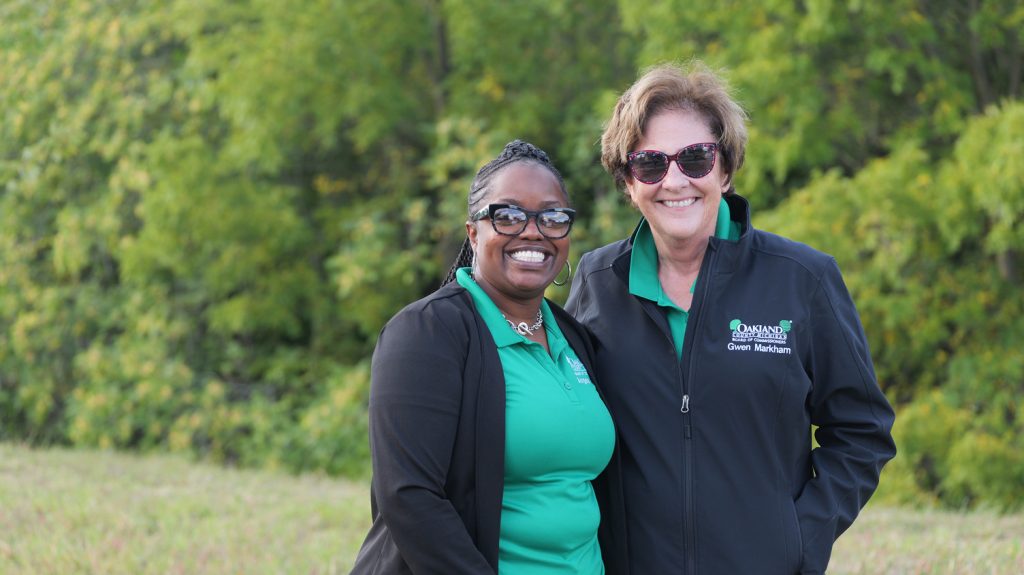
“Webster was always a community center—it just happened to be a school,” says County Commissioner Gwen Markham, reflecting on its legacy as a civic anchor on Pontiac’s west side.
When Micah 6 purchased the building in 2017, it was a shell of what it once was—stripped by vandals and deteriorated by time.
Executive Director Coleman Yoakum says the vision to restore Webster came directly from neighborhood input.
“We interviewed 242 people in our census tract asking what they would want to see in a community center,” Yoakum says. “With that data, we went to prospective tenants and invited them to move into the building once it was renovated.”
The community’s response was clear: they wanted a place to gather, learn, and grow. And now, after years of fundraising and planning, that dream is becoming reality. The $34 million project broke ground in April 2024 and is expected to open in early 2026.
The restored space will host tenants including Honor Community Health, OLHSA Head Start, Accent Pontiac, Rochester Christian University, and the Webster Food Market. Together, these organizations will offer health care, early childhood education, arts programming, higher education, and access to fresh food—all under one roof.
Casey says the project embodies what the Pontiac Funders Collaborative aims to support: resident-led, sustainable development.
“The Webster Community Center was driven by direct input from Pontiac residents,” she says. “It’s a perfect example of how listening to the community can lead to long-term impact.”
Oakland County’s downtown redevelopment: A new chapter for Pontiac’s core
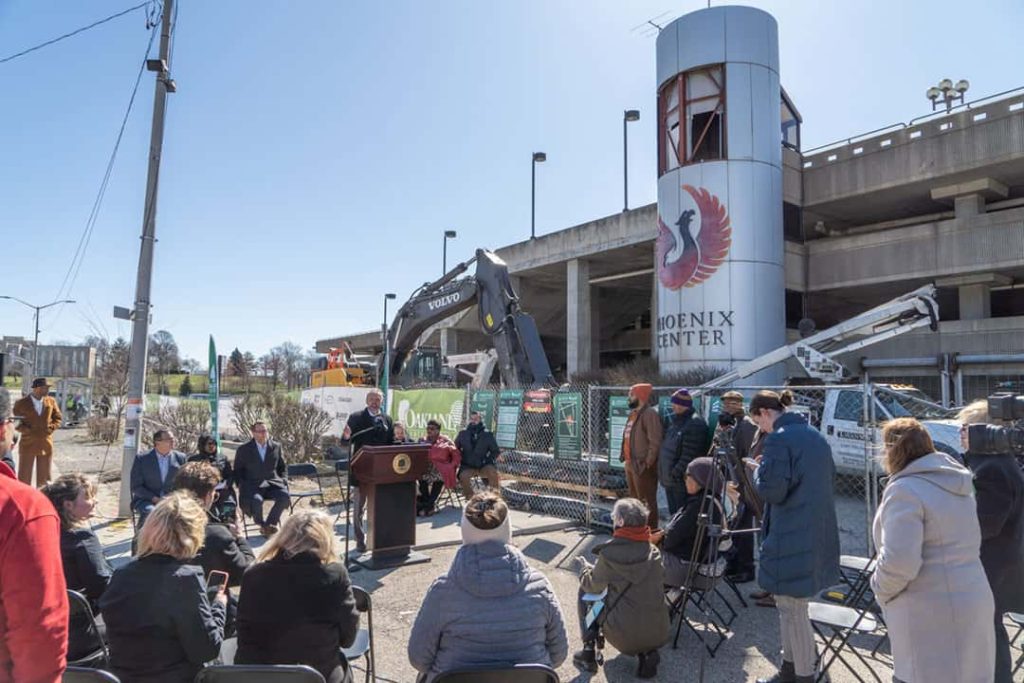
Just a few miles away, another transformation is underway—this one redefining the city’s downtown landscape. Oakland County’s Downtown Pontiac Redevelopment Project is a sweeping effort to reactivate the city’s core by investing in government services, infrastructure, and economic vitality.
The initiative, led by Deputy County Executive Sean Carlson, began in early 2023 when the county acquired several key downtown properties: the Phoenix Center Garage, and two former General Motors buildings at 31 Judson and 51–111 Woodward Avenue.
“The first part was just exploring whether this was something we wanted to do,” Carlson says. “We moved forward with the acquisition of the property, and now we’re building the framework for the next chapter of downtown Pontiac.”
The aging Phoenix Center Garage, once seen as a symbol of Pontiac’s stalled redevelopment, was demolished earlier this year. Carlson says new parking structures will soon rise in its place, setting the stage for a modernized government campus that integrates state and county services in a more accessible, pedestrian-friendly environment.
The redevelopment will house multiple Oakland County departments, including Economic Development, Fiscal Services, Workforce Development, Human Resources, and Veterans Services, alongside the county’s health clinic and state offices for the Department of Health and Human Services.
“It will be a great one-stop shop for people who have government needs and services,” Carlson says.
The project also aligns with the upcoming redesign of the Woodward Loop by the Michigan Department of Transportation, which will transform the current “racetrack” design into two-way streets to better connect downtown with surrounding neighborhoods.
Carlson says the redevelopment is about much more than new buildings—it’s a catalyst for long-term economic growth across the region.
“This is not only going to help Pontiac,” he says. “It’s going to help Oakland County and Southeast Michigan. We’re bringing 700 employees downtown, and we expect this to spark major investment and development, similar to what’s happened in Detroit.”
That investment is already taking shape. McLaren Health Care recently announced plans for a $60 million emergency room expansion, citing Oakland County’s downtown commitment as a driving factor. Developers have also begun converting nearby properties into lofts and mixed-use spaces.
Carlson says the county expects an economic return five to six times its nearly $250 million investment.
“When we look at our peer counties across the country, none of them have a hub zone like we do in the middle of the county,” he says. “This project gives us that center—and gives Pontiac the energy it’s been waiting for.”
Norton Street Innovation Project: Growth and sustainability
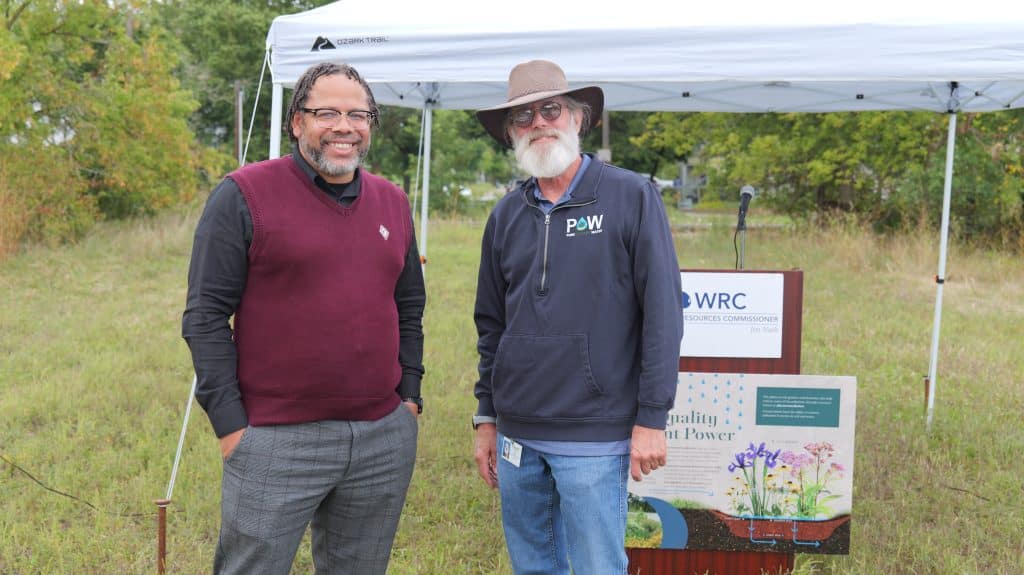
Pontiac’s reinvestment extends beyond downtown, too. The Norton Street Innovation Stormwater Improvement Project, completed in September, transformed five acres of underutilized land into a green infrastructure site that manages runoff and brings new life to the neighborhood.
The $1.3 million initiative, developed through the Oakland County Water Resources Commissioner’s Office, was designed to treat stormwater before it enters the Augusta Drain. The project includes curb cuts that channel runoff from Norton Street into large-scale bioretention areas—essentially rain gardens—that filter pollutants before the water seeps into the ground.
“The grant funding was for nonpoint source pollution, which can come from road runoff or yard waste,” says Stephanie Petrillo, environmental planner for the Water Resources Commissioner’s Office. “The stormwater is directed into the cells so it can infiltrate into the ground and keep pollutants out of the water that ultimately enters the Augusta Drain.”
The property, which had long been an open grassy lot owned by the drainage district, presented a unique opportunity to transform a forgotten space into something functional and beautiful.
“It was kind of a good opportunity to do some green infrastructure to make it more of a showpiece for the neighborhood,” says Jen Cook, the county engineer who oversaw construction. “Now it’s a showcase of what we’d like to do on a wider scale—proof of concept that residents are happy with the results and that it looks so much nicer than it did before.”
Community engagement was built into every step of the process. Before design work began, the team hosted multiple public meetings to gather feedback from residents on what they wanted to see in the space.
“We showed them photos of ideas we were thinking about—things like walking paths, benches, and native landscaping,” Petrillo says. “We took those responses and included as many of those features as we could within the budget. The whole point was to put something there that the residents wanted to use and wanted to see—and I think we achieved that.”
Trisha Bruzek, marketing and communications officer for the Water Resources Commissioner’s Office, says community response has been overwhelmingly positive.
“When we held the ribbon-cutting event, people were ecstatic,” she says. “They were so happy to have an area to walk and see the green infrastructure. One woman in her 90s said she’s seen new species of birds in the area that she’s never seen before—that’s how you know it’s working.”
The project also inspired new collaboration between the Water Resources Commissioner’s Office, the City of Pontiac, and Oakland County Parks and Recreation, which donated native plants for residents to take home and learn about at engagement events.
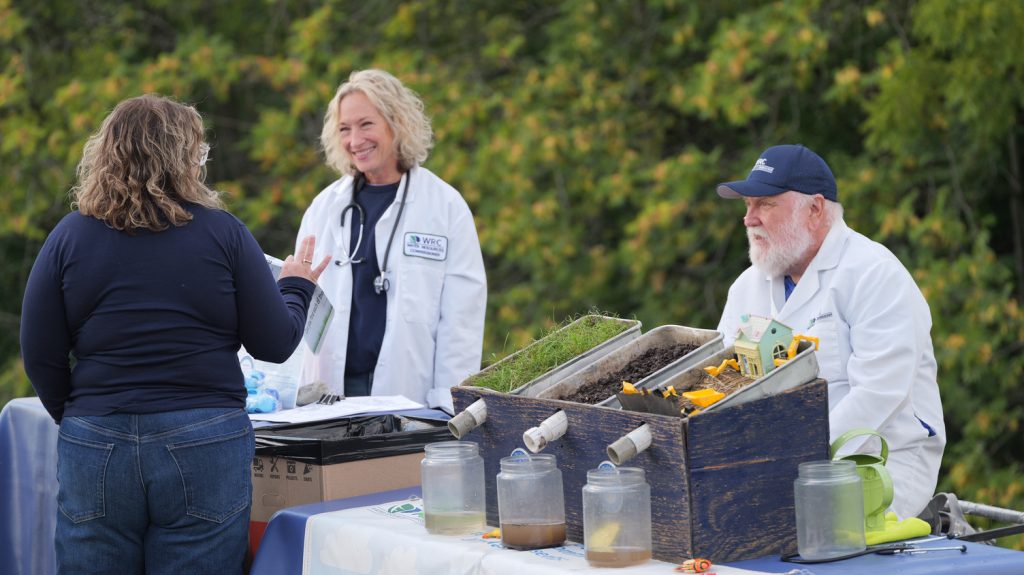
“It was part education and part partnership,” Cook says. “We talked with residents about native plants, soil infiltration, and how changing landscapes can improve water quality and habitat. Everyone really put in the effort to make sure we all knew what the goals were and what we wanted to achieve.”
From the rebirth of a historic school to the revitalization of downtown and the greening of a once-empty lot, Pontiac’s story is one of transformation—powered by its people and partnerships that see beyond the past to what’s possible next.
Author

Related Articles
Wixom’s West End Commons project, launching this Spring is empowering downtown and expanding the city’s social district
As West End Commons prepares to break ground, Wixom’s social district continues to serve as both an economic tool and a community bridge.

From past, present to future, Oak Park celebrates Black history year-round
Oak Park has a long history of celebrating diversity, from Black History Month to its pinnacle summer Juneteenth event.
Farmington’s focus on public art fosters economic growth
The City of Farmington’s collaborations support its vision of leveraging public art as an economic driver.


