
Innovation U.
Marcel Proust once said, “The real voyage of discovery consists not in seeking new landscapes but in having new eyes.” To wit, Michigan’s smaller universities are enthusiastically expanding their commitment to research, understanding that high-tech talent and innovation are needed to remake the state’s economic landscape.
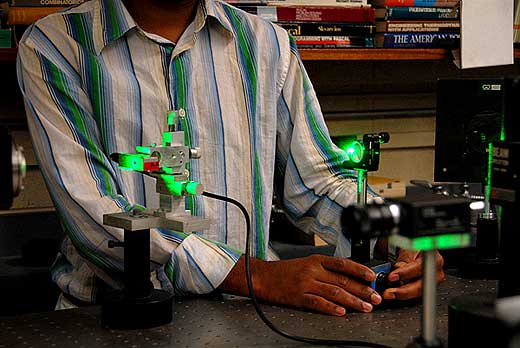
According to Michael E. Porter, Harvard Business School’s leading authority on competitive strategy and international competitiveness, “Innovation is the central issue in economic prosperity.” One has only to look at recent history to see how true this statement is. North Carolina’s Research Triangle, Silicon Valley and Seattle have all benefited from a robust research environment. It’s this convergence of academic and economic development that local universities are hoping to nurture.
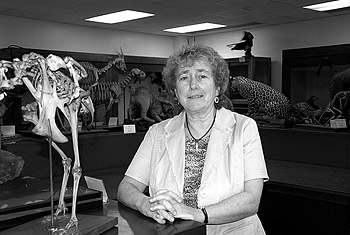 Despite a decline in governmental and philanthropic support, claims of a regional “brain drain,” and difficulty recruiting faculty researchers and post-doctoral students, research labs in southeast Michigan actually seem to be growing –and not just at the University of Michigan. Smaller institutions like Wayne State University, Oakland University and even Lawrence Technical Institute are vigorously expanding facilities, investment and curriculum in an attempt to bolster their reputation as institutions of both higher learning and ground-breaking research.
Stepping out from behind U of M’s very long research shadow, Wayne State, in particular, has been working hard to establish itself as a world-class research institution, explains Miriam L. Greenburg, Ph.D., associate dean for research at its College of Liberal Arts and Sciences. Ranked in the top 25% for NIH funded research, WSU was listed last year among the top 14 research universities in a national readership poll of “The Scientist,” a magazine of the life sciences.
Show them the money
Even with that federal support, however, not every WSU scientist recieves funding. To help nurture promising work, the university often invests directly in its researchers, helping them to make it to the next step. This commitment to its faculty is one of the reasons for WSU’s rising reputation as a serious research institution. Along with internal “seed” grants for investigators in the earliest stages of their work and “bridge” funds for experienced scinetists who need extended support during funding gaps, the university has developed an “enhancement” grant program in order to stimulate interdisciplinary research. Last year, several nanotechnology labs received support, explains Dr. Greenberg, and as a result they are more likely to receive outside funding.
Wayne State is hoping its commitment to life sciences research (biology, medicine, and genetics) will emulate their tech-transfer successes like Sensound, which became a start up company operating out of Tech Town.
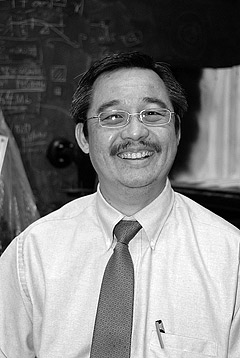 Tachung C. Yih, Ph.D., vice provost for Research at Oakland University, agrees that the opportunity to work in a supportive research environment – one that compensates generously – is how research will grow in the region. Dr. Yih relocated to Oakland last summer from the University of Texas in San Antonio, despite the prevailing belief that the best and brightest are leaving Michigan. It’s all about “the challenge,” he says.
An established researcher in nanomedicine, Dr. Yih joined Oakland to help elevate its research program to the level of the other major universities in Michigan. In his opinion, the critical component to attracting research talent is financial investment. “If you pay well, people will come,” Dr. Yih states plainly.
The vice provost goes on to explain that local research programs need to double and triple their efforts, maximize their creativity to make enough money to recruit superior students and post-doctoral fellows, which are necessary to good research. He believes researchers will follow good economic offers regardless of the popularity of a region. It’s a strategy he employed successfully at Dallas/Arlington and one he hopes to repeat at Oakland.
Dr. Yih has also been working to evolve Oakland’s better-established research centers, such as the Eye Research Institute, the Center for Biomedical Research, and the internationally recognized Fastening and Joining Research Institute. Like Wayne State and U of M, Oakland is aggressively establishing private sector partnerships to develop its applied research and supplemental grant money; money that previously came from government and philanthropic sources. “This will one way of revitalizing our [local] industry,” he explains. “They don’t have to (spend) much money. The university is cheaper. You don’t have to go to an industrial research company. At the same time, we’re educating our next generation workforce.”
To illustrate his point, Dr. Yih points to Nanorex, a Bloomfield Hills company that designs and develops structural DNA nanotechnology. The company has created a joint venture with Oakland University that will lead to a Center for Nanotechnology and there should be further announcements about thsi partnership later this summer.
A new focus, a new reputation
 Lawrence Technological University currently has a study underway to examine support beams on the Bridge Street bridge in Southfield, explains Joseph Veryser, AIA, interim director, Center for Sustainability. Structural civil engineering researchers are comparing the relative strength of carbon fiber reinforced bridges to traditional steel reinforcement. The study’s early success led to funding the Center for Innovative Material Research, which supports continued research in bridge design and testing, as well as bridge structure hardening and other applications, he says.
Although not known as a research university, Lawrence Tech’s faculty has launched independent research in structural design, building construction, and site engineering. This has led to a convergence of interest, now known as the Center for Sustainability.
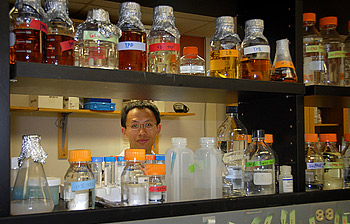 As a “university architect,” Veryser reviews all new projects on campus for their sustainability, not only for environmental reasons, but for learning and research opportunities. For example, onsite research is evaluating the benefit of the “green” roof on the new A. Alfred Taubman Student Services Building. There are numerous other examples of cross-disciplinary research between architects and engineers on campus projects, which is how the university promotes a culture of innovation and applied research. “We do research that is incidental to the specific needs in our colleges,” Veryser says. Lawrence has established a certificate of sustainability (also referred to as “green design”) in Architecture and plans to establish a Center for Undergraduate Research in Sustainability.
Though not regarded as “great research,” –the kind of life-changing investigations associated with world-class institutions– the Center’s projects provide an  opportunity to demonstrate and evaluate alternative ways of creating sustainable structures, Veryser explains.
In the case of photovoltaic cells, it was Lawrence Tech’s research that proved “it can be done, it was practical to do, it was economical to do, and we were able to demonstrate to our students and those who visit the campus that it should be done.” How?
From the relatively small academic setting like Lawrence Technological University, to the progressively larger Oakland and Wayne State universities, academic research is thriving in tough times, through innovative approaches to creating new knowledge and supporting economic development. Still, there remains an even greater opportunity – collaboration.
Just as interdisciplinary collaboration creates synergy, intercollegiate collaboration can as well. And by bridging the ivory towers, a knowledge community could be born. There is plenty of intellectual talent in the region despite the “brain drain,” says Dr. Yih. “The problem is, there isn’t an intellectual community. …We have to promote this in a more aggressive manner; put people together and hopefully make successful matching and collaborations.”
Dennis Archambault is a Detroit-based freelance writer and regular contributor to metromode and Model D. His last article with metromode was Taking It Downtown.
Photos:
Shuliang Chen, Ph.D. Student, WSU
Related Articles
Indiana health center trains local residents as dental assistants to fill workforce gaps
HealthLinc, a federally qualified health center in Valparaiso, covers training costs while preparing local residents for dental assistant jobs, strengthening workforce pipelines and expanding access to care.
Wixom’s West End Commons project, launching this Spring is empowering downtown and expanding the city’s social district
As West End Commons prepares to break ground, Wixom’s social district continues to serve as both an economic tool and a community bridge.

“We’re home now,” Hazel Park’s new Romanian restaurant Bar Gabi blends old-world flavors with a modern twist
Romanian couple Gabriel and Gabriela Botezan are blending soul and childhood memories of cooking with family by serving up classic Romanian dishes with a modern edge in Hazel Park’s newest bistro.


