
Green Up Top
It’s the urban trend all the kids are talking about! Green roofs are taking root in cities all over America, reducing pollution and creating energy efficiency. Kelli Kavanaugh looks at how Metro Detroit can move up from the back of the pack.
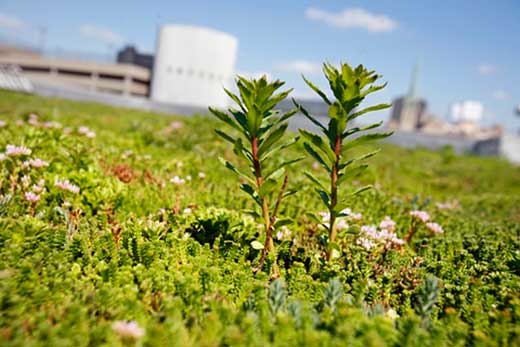
Like pretty much every other building component, roofs are going green. If you’re late to game, a green roof is one that is partially or completely covered with vegetative matter. Those who sing their praises often cite benefits ranging from environmental to economic to aesthetic.
 Environmentally, green roofs absorb and, in some cases clean, storm runoff. Habitat is created for insects and birds. Because the ambient temperature of a building is reduced, less energy is required to cool it. Economically, green roofs tend to last a lot longer than traditional ones. Aesthetically, well what would you rather look at, grasses and plants or a flat black surface glimmering in the heat?
Talking about green roofs in Southeast Michigan is a classic example of a dichotomy. On one hand, it is home to one of the world’s largest and most famous at the Ford Rouge Plant in Dearborn. On the other, it sorely lags behind places like Chicago, New York, Minneapolis and most European cities in terms of sheer numbers of examples.
Metromode will take a look at some local and non-local examples of green roofs, describe some obstacles to implementation and, on the flip side, share some resources that might help demystify the process of making a green roof happen.
Look up and around
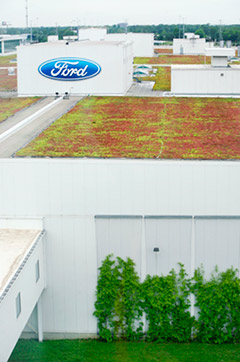
A highlight of the factory tours of the Ford Rouge Plant is the incredible view of the 454,000-square-foot green roof that was installed, to great fanfare, in 2004. It’s part of a site-wide 600-acre stormwater management system that accomplishes an impressive list of objectives, including: the establishment of habitat at roof level, reduction in ambient temperatures and protection of the roof membrane.
Ford estimates a seven percent decrease in energy usage, the retention of 447,000 gallons per year of rainwater and a doubling in the life of the roof from 25 to 50 years.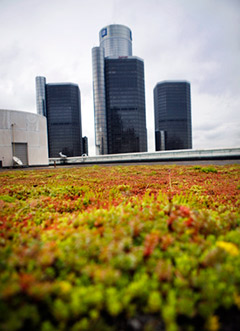
A few miles up the road, in Southfield, A. Alfred Taubman Student Services Center at Lawrence Technological University is a 10,000 square-foot green roof, planted with sedum (that’s the same low-maintenance plant used at the Rouge). Any rainwater that is not evaporated back into the atmosphere is filtered by the sedum roots before running into the Rouge River. Some of the water, however, is captured in a cistern so that it can be used to flush the building’s toilets.
Two smaller, local projects show that green roofs don’t always have to be enormous to make an impact. There’s a cute tiny one on a gazebo at Ann Arbor’s Matthei Botanical Garden and one was recently installed on the roof of the Joe Louis Arena Detroit People Mover stop. Again, the lifespan of the roof is estimated to double, this time to 40 years.
“Its short-term expense is perhaps a little bit more, but in the long run we get twice as much usage,” says DPM manager Dennis Green.
Other notable locals include Upland Hills Ecological Awareness Center in Oxford, the Coleman A. Young Municipal Center in Detroit, which is going green little by little, as its pavers need replacing.
But these local efforts pale in comparison to our big city neighbor, Chicago, which as of 2006 recorded more than 250 public and private green roofs totaling more than 1 million square feet. In 2007 alone, the city added yet another 517,633 square feet, making it, by far, the city with the most green roofs in the country. 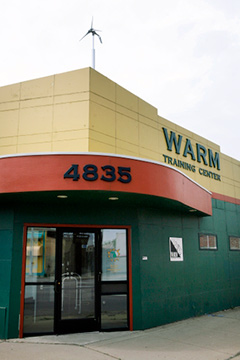 To make their commitment perfectly clear, Chicago’s City Hall also sports a much-lauded green roof.
Some notable green roofs around the country include the California Academy of Sciences, which is topped by rolling hillocks; and the School of Art, Design and Media at Nanyang Technological University in Singapore, which slopes down to enable people to walk on it from ground level and enjoy the green space it provides. It must be seen to be believed.
Obstacles
In the mind of WARM Training’s green programs manager Jacob Corvidae, there are two primary reasons there aren’t more green roofs in the Detroit area: a lack of understanding of their proper applications and financial incentive. “The biggest obstacle in my mind is getting people to realize when they are a good application and when they are not,” he says.
A good example of when they would not be a good application is a high rise apartment building — its verticality in comparison to its relatively tiny roof size make it not worth the bang for the buck. On the flip side, any low horizontal building — big box retail or warehouse or a boxy office building — can make immediate financial sense. Documenting the energy savings and even the value in reducing storm runoff is an important first step to take.
On the financial tip, Corvidae says, “Revolving loan funds to help make this thing move would be big — upfront loan packages would make it make sense in more places.”
HOW OTHER CITIES INCENTIVE GREEN ROOFS HERE?
Interested?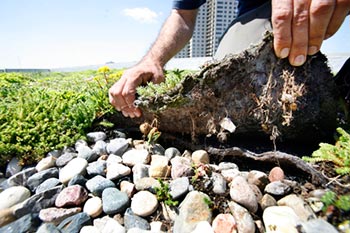
Step one: Cruise the interweb, of course! A great inspirational piece on green roofs in National Geographic will show you the possibilities and Canadian-based Green Roofs for Healthy Cities has an info-laden site.
Do-it-yourselfers looking for a small start should check out Green Roof Blocks. The company makes it easy to green even a portion of a roof with a kit. The modular system can even be moved when a repair to the roof surface is needed. Green Grid Roofs is another option.
Also highly recommended, particularly with larger projects, is consulting with a professional that has experience with green roofs. Two locally are Mannick & Smith Group — the company that worked on the Rouge Plant roof — and Ann Arbor-based A3C, an architecture and design firm with a sustainable bent that recently greened the roof of their 100 year-old downtown building.
Kelli B Kavanaugh….
Related Articles
Farmington’s focus on public art fosters economic growth
The City of Farmington’s collaborations support its vision of leveraging public art as an economic driver.
Collaboration Over Competition: How Downtown Farmington’s community spirit earned national acclaim
From sharing ingredients to using the Syndicate social district, local business owners are coming together as a community to continue driving economic success.
Pints for the Planet: Griffin Claw saves grains from dumps, cuts carbon footprint
Griffin Claw Brewing in Birmingham is changing the brewery game by implementing multiple sustainable practices like sending their brewers’ grain to local farmers and recapturing CO2 to prevent it from entering the atmosphere.


