
Shelter beds will more than double at Pontiac nonprofit Lighthouse as it redevelops campus
A redevelopment project at Pontiac-based Lighthouse will add a new homeless shelter and many improved services for people experiencing homelessness.
This story is part of a series that highlights the challenges and solutions around housing in Southeast Michigan and is made possible through underwriting support from the Oakland County (Region L) Regional Housing Partnership.
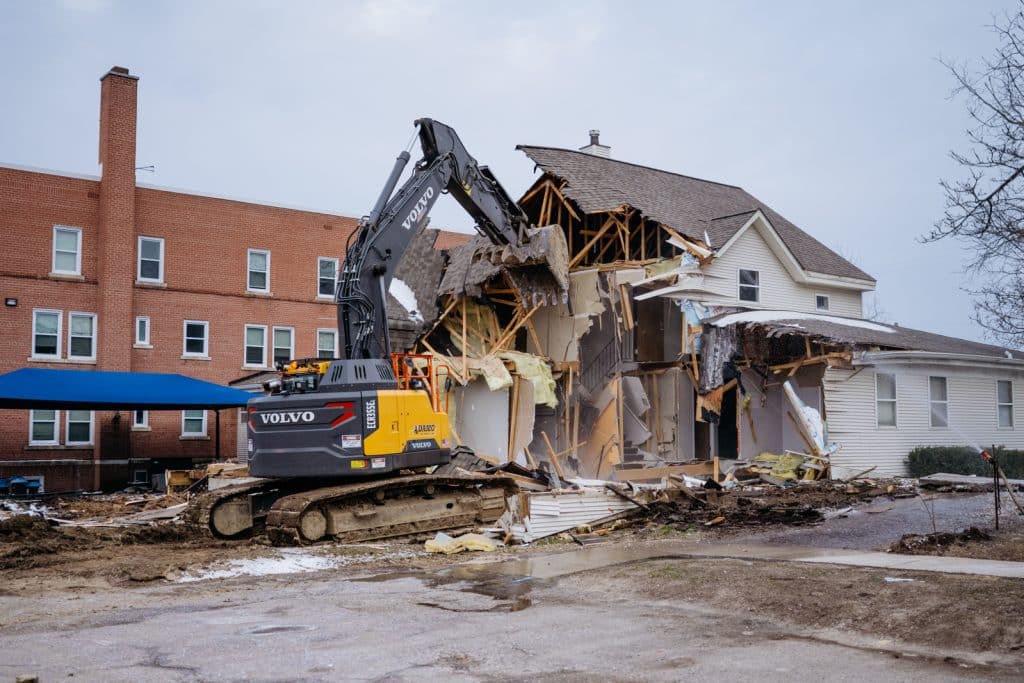
Yesterday Pontiac-based nonprofit Lighthouse demolished an administrative building to make way for a new homeless shelter that will more than double Lighthouse’s current shelter capacity, part of a larger redevelopment project that will add numerous new services for people in need.
The new shelter facility, or Housing Opportunity Center, is expected to open sometime next year. It will include not just beds, but amenities including a laundry room, a library, a computer room, and even a barbershop. Funds are still being raised for a second phase of the redevelopment plan. That phase will entail construction of an Economic Opportunity Center offering access to social workers, financial and employment coaching, and more; a Social Supermarket that will allow clients to shop for free food; community event spaces; and a cafe. The expected cost to complete both phases is $32 million, with $17 million having been raised so far through Lighthouse’s “Lighting the Way” capital campaign.
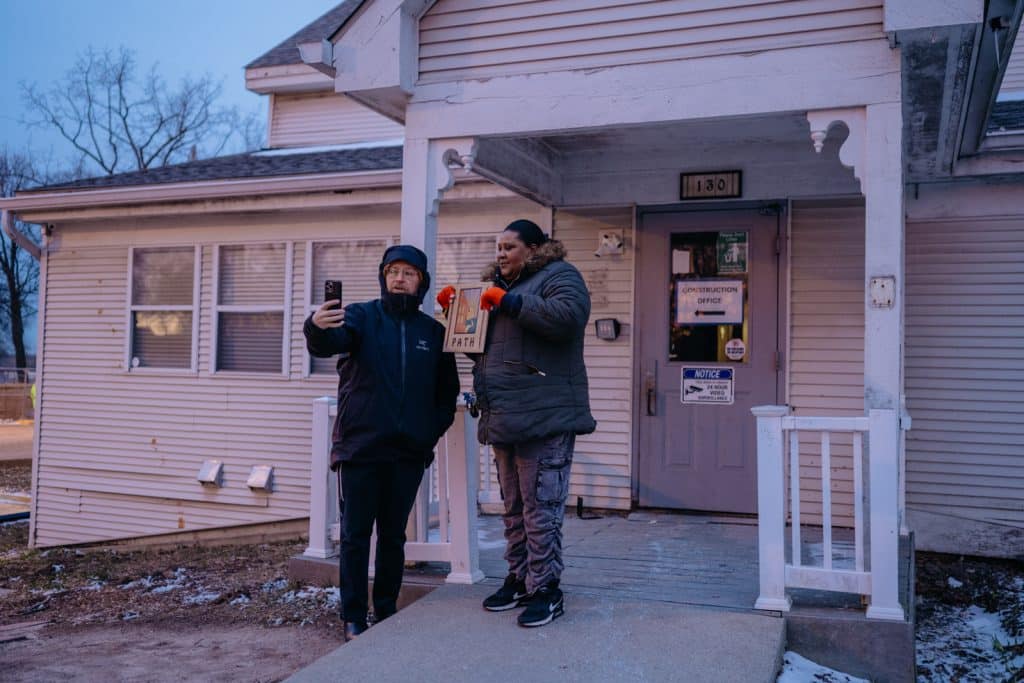
Lighthouse staff say their redevelopment plan was strongly influenced by their experience trying to serve their community during the COVID-19 pandemic. At that point Lighthouse’s emergency shelter had no fixed home, having rotated through local churches and synagogues for 35 years. The system offered little privacy, dividing men, women, and families into three large areas at each site.
“Once COVID hit, we realized we’re doing the best that we can with what we have, but this isn’t ideal for serving our guests,” says Jessie Polito, Lighthouse’s director of emergency services. “There are some benefits to rotating. You get to see geographic locations. There’s networking involved. But it’s also a lot of work to uproot your life every week and transition to a different unknown location.”
Lighthouse staff also sought to address an overall lack of family shelter beds in Oakland County. Lighthouse CEO Ryan Hertz says he’s “excited for what this means for our community’s ability to serve people with dignity.”
“This process pushed us to dream bigger and pushed us to stretch what we believe is possible,” he says. “And we hope that it’ll stretch what others believe is possible, and will bring partners and funders and others along with us to do better for our neighbors.”
Phase 1: Expanding shelter capacity and amenities
The demolition of the administrative building and two other underused buildings on the Lighthouse campus will clear the way for the three-story Housing Opportunity Center. The redevelopment will add 98 shelter beds, giving the organization a total of 150 beds, in individual rooms rather than a congregate setting. Lighthouse COO Jenny Poma says the expansion will allow Lighthouse to serve the same number of people it did during the peak of the pandemic.
“We were never meeting the full need,” she says. “… We know that there’s that need. Even when there’s not a pandemic, there’s that need in the community.”

The design of the new facility was heavily influenced by feedback from Lighthouse clients. Polito says clients specifically requested on-site laundry, a library, internet access, space to do arts and crafts, and a beauty/barbershop area, all of which will be included in the finished building. She says clients also requested “homework nooks” in each of the shelter’s rooms so that children could minimize distractions while keeping up with their schoolwork.
“It’s really important for us to ensure that it’s truly a family-oriented space,” Polito says. “At any given time, two-thirds of our guests are children. And so we want to make sure that it’s accessible for children, that it’s accessible for families, that they truly feel welcomed in that space, that it’s not an adult space that happens to have children.”
Polito describes the project as “an exciting opportunity” to offer Lighthouse clients “autonomy as they navigate their housing needs.”
“It’s been a long time coming, and to finally see the construction happening … is just so encouraging and motivating and inspirational,” she says.
Phase 2: Making services more accessible
The planned second phase of Lighthouse’s campus redevelopment project will enhance the nonprofit’s capacity to help its clients get back on their feet. Poma says Lighthouse’s “primary goal” is to get its clients “out of shelter as soon as possible into housing.” In order to do that, she says the nonprofit already offers case managers who help clients access rehousing programs, find employment, and more.
“We hope to kind of expand and formalize those services for the Pontiac community at large when we redevelop the other side of our campus that’s attached to our headquarters,” she says.
Clients visiting the Economic Opportunity Center could meet with financial navigators and employment coaches. They could go to a health care appointment or use a computer lab. Or they could visit the Social Supermarket, which Poma contrasts to Lighthouse’s current food pantry, located on the second floor of the nonprofit’s administrative office.
“We pre-pack boxes, people come, and we distribute those pre-packed boxes,” she says. “The Social Supermarket will really feel like a supermarket, where people can come in, select the food that they want, and have that kind of client choice.”
Social workers will also be on hand at the Social Supermarket to discuss other needs with clients, potentially making simple referrals to services in the same building. Poma says the overall goal of the redevelopment’s second phase will be to make Lighthouse services more “visible and accessible” to clients, creating an easy one-stop shop for them to fulfill a variety of needs.
Poma says she’s been working in homeless shelters since she was in grad school, which has usually involved “scrapping for resources” and struggling to serve people in need on a tight budget.
“Being this far into the game and actually making an investment into something that will permanently increase Oakland County’s capacity to serve people experiencing homelessness is pretty … phenomenal, to be able to see that growth and be a part of that story,” she says.
Hertz emphasizes that the redevelopment project remains a “work in progress.” Amidst rising construction costs and dramatic shifts in federal funding priorities, he says it’s “incredible” that Lighthouse has reached the point of breaking ground on the first new building of the redevelopment.
“We hope folks who are moved by hearing the story of how we got this far will take an interest and will reach out,” he says. “We’re happy to show people on the ground what’s happening in real time to consider investing in this asset for our community for many years to come.”
Related Articles
West End Commons brings community together in downtown Wixom
A years-in-the-making effort to develop a new gathering place in downtown Wixom is nearing completion with the creation of the ‘third space’ gathering center, The West End Commons.

Partner Partner Content Creativity and community come together at Farmington’s new Art Park Promenade
Farmington’s Art Park Promenade connects Riley Park with the Hillside Townes development through a pedestrian-friendly space filled with landscaping, seating, and public art.
Oak Park opens new event hub, celebrates years of community investment
Oak Park looks ahead after fulfilling promises to residents on the Elevate Oak Park initiative.


