
Facility dogs provide helping paws addressing mental health concerns among Metro Detroit schools
In partnership with Canines for Change and Priority Health, Priority Pups have been introduced in three Metro Detroit schools to help support mental health, teach responsibility and symbolize caring relationships.
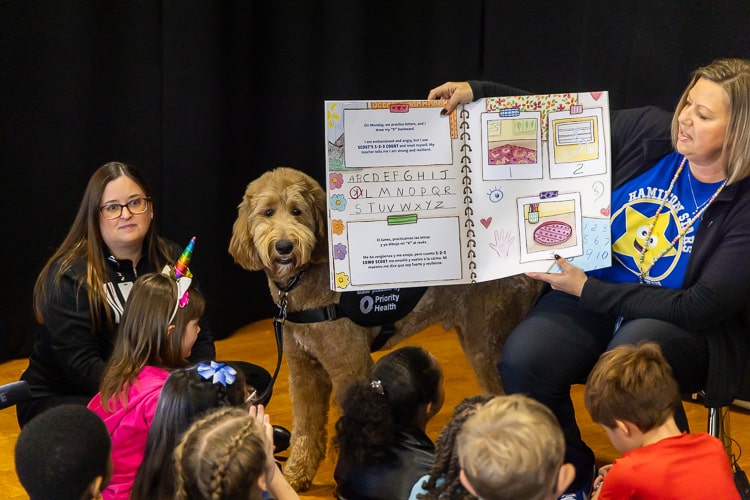
They say that dogs are a man’s best friend, but for many young boys and girls across Metro Detroit schools, these furry friends are more than just companions. These pups are supporting mental health, increasing motor skills, teaching responsibility, and fostering caring relationships.
In an effort to continue their mission of supporting mental health in students, Priority Health has placed three highly-trained working facility dogs in schools across Southeast Michigan.
After launching the program in West Michigan in 2023, Priority Pups (a registered trademark) has expanded to include the Metro Detroit area. Beau, Charlie, and Madden are all goldendoodles who spend time at Covenant High School Central in Detroit, Plymouth-Canton Community Schools, and Wayne-Westland Community Schools.
In partnership with the nonprofit Canines for Change, Michigan’s leading facility and service dog organization, Priority Pups provides specially trained dogs to support emotional regulation, academic engagement, social connection, and even staff well-being at their placements. The organization owns the dogs and lives with a trained staff handler.
The program also includes “Frida’s Fireworks,” a children’s book that discusses mental resilience and helpful tools for school-aged children.

On Oct. 29, members of the media were invited to meet with these handlers, dogs, students, and staff at Hamilton Elementary School.
“It was awesome to show our community all of the hard work that our dogs have done to be able to work with your students and staff,” says Amanda Faughnan, supervisor of mental health and support services for Wayne-Westland Community Schools.
Kelley Michels, principal of Hamilton Elementary School in Westland, says in addition to the work of the dogs and handlers, it was also a display of collaboration.
“It shows the commitment from Priority Health, and all of the people that really made this happen,” Michels says. “Amanda has been spearheading this from the get-go. She really brought all of this to Westland, and I think it’s amazing she stuck with it through all of the difficulties that it takes to get something like this approved and into a school. It just creates this opportunity for conversations around the social and emotional needs that students everywhere have.”
Dogs for Mental Health
For the past three years, Faughnan has tried to find the right fit for bringing dogs into the school district. After conversations with various community partners, she learned about Priority Health’s programs and was connected to Canines for Change.
“I was able to work with Hamilton Elementary School so that Madden could work here, but also throughout our district. He is a part of our district crisis team, he gets to attend events, and provide support throughout our entire district,” she says.
After an increased need for mental health services and resources in a post-COVID-19 era, Faughnan has seen a greater prevalence of depression and anxiety during the school day. Nearly one in five kids struggles with mental health issues, and Dr. Charletta Davis, the medical director of behavioral health at Priority Health, says she sees the same type of demographics across all school districts.
“For school-aged children, the relationships that can flourish between a child and animals can give a sense of calmness, and can help reduce anxiety and stress,” Davis says. “Having the opportunity to place dogs in schools gives that sense of relief for the children. It aids them in wanting to learn and to participate in activities in the school setting.”
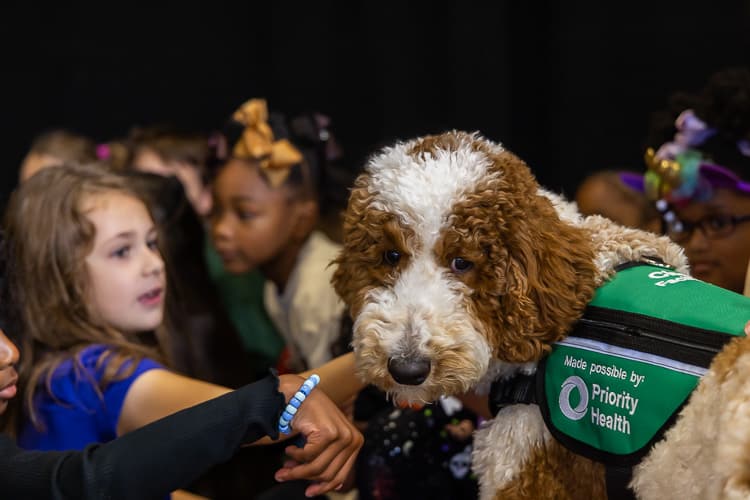
Michels has witnessed a positive effect of the dog’s calming presence on campus.
“The immediate change at Hamilton is evident,” she says. “This just changes the dynamic and environment of the school. Just seeing him [Madden] brings people joy. When kids are feeling anxious, and the dog comes and puts their body in proximity, giving them that little bit of comfort with pets and dog snuggles, it gives them a helpful sense of comfort.”
She adds, The Priority Pups, including Madden, have a social media presence, which has increased conversations about the potential benefits of facility dogs, even outside the district.
“It’s creating conversation around the need for students to have mental health support, and the needs of our students in relation to social and emotional learning and the adverse childhood experiences that so many kids experience — regardless of your socioeconomic status,” she says. “It really has highlighted that, and Madden is the catalyst to get that conversation happening.”
It’s not just the students who are feeling the love from Madden’s presence. Staff have been positively impacted by the one-year-old dog, who was introduced to the school in May.
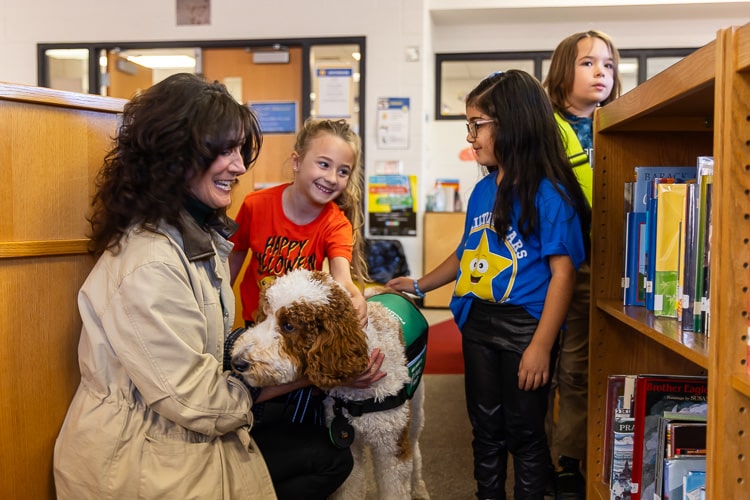
“We have staff that have lives outside of school, experiencing challenges with family members, illness, divorce, and death,” Michels says. “To have our staff members come and take him for a walk, it gives them a few moments of peacefulness and mindfulness when they take him outside for a walk, or come into the office and sit with him.”
Although Madden is, in fact, therapeutic to those around him, Faughnan wants to address the distinction between therapy dogs and facility dogs.
“We want to protect the facility dogs and the certification that they work so hard for. Therapy dogs are different in that they visit a location at a designated time with their handler, and they leave and go home,” Faughnan says. “Madden is owned by the district. He doesn’t just come to visit Hamilton, he will be here three or four times a week. One of his handlers is a first-grade teacher, and he will be with her or another staff person with additional training. At that point, he’ll be able to interact with a classroom, rolling dice and pressing a button to open a door. These are different skills that can be used in the classroom, in addition to walking and greeting students.”
Students also get the chance to learn responsibility and ownership of the district dog by putting water in his dish and how to properly care for him. Students also learn how their actions can impact living things.
Faughnan and Michels hope that after Madden visits other buildings’ staff and students, the program will be able to grow to other districts and regions in the future.
“My goal is always to support students and families in the best way possible, whether it’s at Hamilton or anywhere in the community to effect that change,” Michels says. “I think this is where it starts.”
Photos by David Lewinski.
Author

Related Articles
Oak Park opens new event hub, celebrates years of community investment
Oak Park looks ahead after fulfilling promises to residents on the Elevate Oak Park initiative.
Yale’s Heart & Soul Project puts residents at the center of community planning
For the past year, volunteers in Yale have been collecting stories and ideas from residents that organizers hope will eventually shape future community priorities.
Micro forests attract not only birds and bees but Metro Detroiters, too
Whether you call them micro, mini, or pocket forests, they are taking root around the world — and in metro Detroit. They help the environment, provide refuge to native species, and respite to people seeking green spaces — especially in urban areas.


