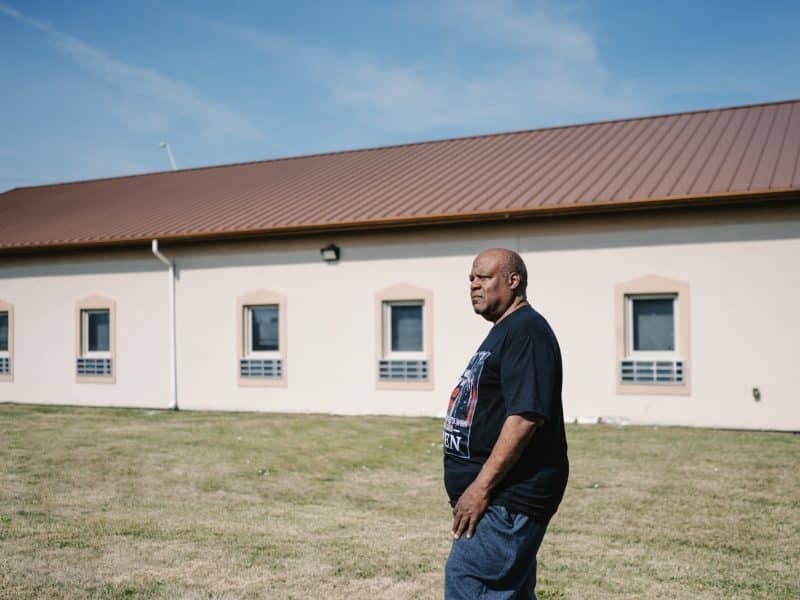
It’s windy and warm, eleven o’clock in the morning, the day after Labor Day and some shirtless men with tattoos and a few women are bent over picking tomatoes and peppers from a rich urban garden at the noisy intersection of Cadillac and Edsel Ford Freeway. All of the workers are adult felony offenders, sentenced to a residential facility on Detroit’s eastside, for nonviolent crimes like possession or selling illegal drugs.
“This is a second chance for me,” said Miguel Rios, 37, of southwest Detroit. “I was facing six to 20 years (in the state prison). So if I don’t get it right this time, I’m going up to the state.”
The Wayne County program – Urban Farming Initiative for Reentering Citizens – replaces blighted lots with colorful vegetable gardens, grows fresh produce for Detroit neighborhoods and helps transition felons who work the gardens back into the real world.
“It’s amazing how you can take something like a blighted lot that’s drab and uncouth,” said Ian Ferguson, 33, of Garden City, “and make something beautiful and pleasing to look at. It gives you that sensation of accomplishment, a sensation of satisfaction.”
Ferguson’s been at the facility for nine weeks for a substance abuse problem.
The Urban Farming Initiative, which won a National Association of Counties achievement award this year, began in 2004. It’s a partnership among Wayne County, the nonprofit Urban Farming Inc., six residential facilities, the city of Detroit and the Wayne County Michigan State University Extension Program.
Urban gardens and corrections

The gardens are relatively novel to these residential facilities. They are modest in size but produce, literally, tons of free, fresh produce for the residents in the surrounding neighborhoods.
Access to fresh produce is critical in an area like Detroit where full-service supermarkets, grocery stores and neighborhood markets have virtually abandoned the city, leaving what experts call a food desert.
Carlton Flakes, program manager for Wayne County’s community corrections division who oversees offenders in the facilities, likens the gardens to the victory gardens of World War II.
“These gardens are open to the community,” Flakes said. “The produce in the gardens are theirs to pick and use.”
And the residents where the gardens are located have picked the fresh produce and warmed to the adult offenders who typically work the gardens three times a week.
Officials close to the program have observed on occasions residents in the neighborhoods near the gardens letting the workers into their homes for drinks of water or to use the bathrooms. A trust has built up.
“We do intermingle with some of the people in the neighborhood,” said Rios, who will be going home to his wife and four children after he serves out his sentence, hoping to get a job. “They are pleased the way things are going. They are like ‘You guys are doing a great job.’ And it’s for the community, it helps us enrich the neighborhood.”
In 2009, approximately 50 offenders worked in the urban gardens in Wayne County. They put in more than 1,100 community service hours – part of their sentences – planting seeds, tilling the earth, watering and harvesting tomatoes, cabbage, green beans, lettuce, seven tons worth last year.
“They receive community service credit for their performance,” Flakes said. “Plus they get the opportunity to work in the garden, plus they get to give back to the community from which they have taken. We consider it work therapy in many instances.”
The non-profit Urban Farming Inc. provides valuable resources, free of charge, to the urban garden program, from supplying seeds, trucking in compost, to teaching the felons the abc’s of vegetable gardening.
The Michigan State University Wayne County Extension Master Gardener Program provides training as well.
Jeffersonian

Recently, the Rev. Jesse Jackson referred to Detroit’s urban farming interest as “cute but foolish.” But the people involved in the urban garden program in Wayne County are under no illusion that gardening is going to replace the thousands of high paying manufacturing jobs that have left the region.
The gardens grow nutritional produce for a community which no longer has supermarkets to buy fresh vegetables, Flakes said. In addition, the offenders working the gardens come to realize that there’s another side to life, he said.
“It clears their heads,” Flakes said.
Ferguson, who is on the kitchen crew and cooks with the fresh produce, said his experience working the gardens has been positive.
“It’s always therapeutic,” he said, “keeps your mind occupied. What’s the saying – ‘Idle mind is the devil’s workshop.’ The garden keeps you occupied.”
Thomas Jefferson was an advocate of agrarian republicanism, that is, the belief that a country can only be built around a class of virtuous yeoman farmers. He believed that cultivators of the earth were vigorous and virtuous, the most valuable citizens. While some could argue that the offenders in the program are there precisely because they were not virtuous, listening to program personnel describe the program conjures up Jeffersonian ideals.
“It’s been so significant,” said Shelia Crawford, a treatment counselor and coordinator of the garden program at Operation Get Down, on the eastside. “And somehow some of the guys and girls, they connected with their recovery. Like when you are taking weeds out, if you don’t take the weeds out of the garden, they’ll cause the good vegetables to die off. So they know they’ll have to weed some people out of their lives or they’ll die off. So it’s been very therapeutic.”
Fallow land
The challenge for all of these nonviolent offenders, Flakes said, is going back into the community and finding work. With minimal formal education and a poor skill set and with the local economy stuttering, the prospects for these clients are limited.
Flakes said he’s working on starting a partnership with The Eastern Market. Perhaps the Market can offer some opportunities for offenders once they leave the residential facility having paid their debt to society.
Flakes also noted that eventually he’d like to see the program venture out in future years to canning and marketing the produce, from seed to sales, so to speak.
And that’s important for the participants in the program.
“I want to get employed before I leave here,” Rios said, who has a job lead at Ford Field. “Because that’s one thing, when you get back into the neighborhood without a job the inevitable is going to happen. Because you are going to get stressed out, bills are going to start piling up, and the fastest way out of it is going back to what you know.”
Pat Dostine is deputy press secretary to the Wayne County Executive and a frequent contributor to the EDGE newsletter.
Photographs by James Wallace, who works in the Communications Division and is part of the creative team.